

Diving Into The Deep Blue C

Professional Biography:
In the technology realm, others see code. I see art. My journey as a software engineer is fueled by a steadfast conviction in the power of creativity to transform our world and the ability of technology to unleash human potential.
As a self-taught developer from Nigeria, I have taken a unique route fueled by a constant inquiry and an insatiable thirst for invention. I spent my five years as a developer growing from a lone learner to a versatile full-stack developer and enthusiast for artificial intelligence. Today, my technological landscape spans web development, artificial intelligence, and blockchain technologies, each established through learning about multiple frameworks.
Technical Skills:
In terms of technical skills, I possess a broad breadth and depth. I know multiple programming languages - Python, JavaScript, Ruby, and C - and possess exceptional knowledge of multiple web technologies - React, Next.js, Node.js, Django, and upcoming frameworks. When I approach code development, I don't just think of it as code. I think of it as compositions. Each line of code is like a musical note bringing functionality together to create a symphony.
Professional Philosophy:
More than skills, I have a vision to create opportunities. Having seen dauntless ambition and unmet creativity in uninviting environments, I believe technology has the possibility of leveling the playing field. I find coding far more relevant than code; to me, it's about giving people a chance to unearth their expression and potential.
Current Frontiers:
I'm currently digging deep into the intersections of AI, web development and blockchain technologies. My excitement surrounding cryptocurrencies and programmable assets stems from a mindset I have toward a more fluid, easier to access digital ecosystem. I view these technologies as tools for innovation rather than things that are far off in the future.
The C is so cool!
Need to build your own badass game? develop a browser? or create a brand new cryptocurrency? If so, then C’s here to help. C works at a much lower level than most other programming languages, so understanding C gives you a better idea of what’s going on. C can even help you better understand other languages as well. So dive in and grab your compile, and you’ll soon get started in no time.
C is a language for small, fast programs
The C language is designed to create small, fast programs. It’s lower-level than most other languages; that means it creates code that’s a lot closer to what machines really understand.
The way C works
Computers really only understand one language: machine code, a binary stream of 1s and 0s. You can convert your C code into machine code with the aid of a compiler.

Example 1
What do you think the above code does?
- create an integer variable called
ageand set its value to20 - create a conditional that checks if the value of the variable
ageis greater than18 - if line 2 is true, displays a text to the terminal or command prompt
Example 2
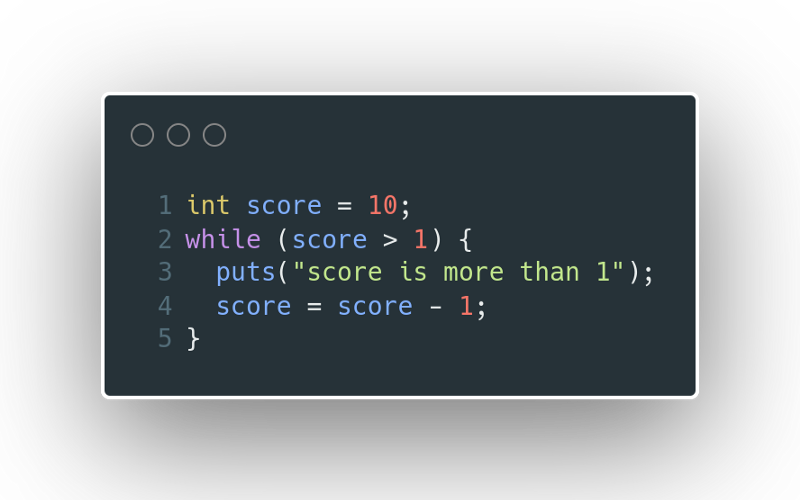
- create a variable called
scoreand set its value to0 - create a while loop that checks that
scoreis greater than1
3. displays a text on the terminal
4. set the value of score to be score minus 1
A while loop is used to repeat a series of actions/steps as long as a condition remains true. Every time the while loop goes through line 4, the value of
scorereduces by 1; the while loop finally stops whenscorereduces to1.
Example 3
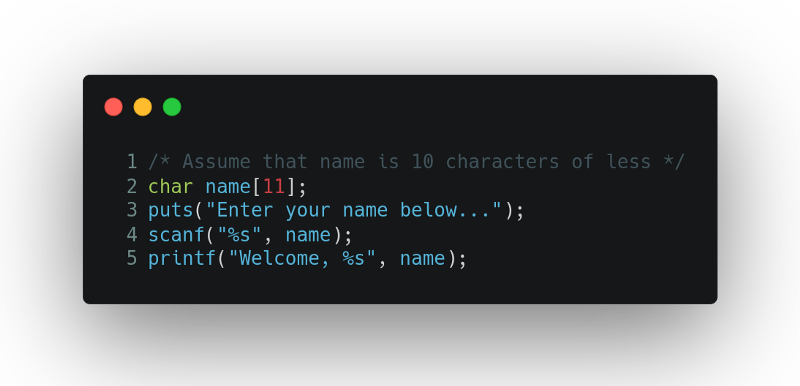
- This is a comment, it’s meant for people reading the program
- Create an array of 11 character
- Displays a message including the text entered.
- Collect input from the user and store it in the array
- Display a message including the text you entered.
%sis replaced withname
When creating an array of characters in C, you should leave additional space for one character just like we did on line 2. C uses this space internally.
But what does a complete C program look like?
Comments
The comment describes the purpose of the code in the file and might include some license or copyright information. A comment is also used to show what a line does or pass some information to other developers who are reading your program.
/*
 * This is a comment
 * It can span multiple
 * lines
 */
The include section
C is a very, very small language and it can do almost nothing without the use of external libraries. You need to tell the compiler what external code to use by including header files for the relevant libraries.
/*
 * The headers you'll see more than any other
 * is the 'stdio.h'. It contains code that allows
 * you to read and write data to and from the terminal
*/


#include <stdio.h>
#include <coollibrary.h>
The last thing you find in the source code are functions
All C code runs inside functions. The most important function you would find in any C program is called the main() function. The main() function is the starting point for all the code in your program.
int main()
{
  /* write some code
   * ...and some more
   *
   * return 0 to show that the program was successful
   * return 1 to show that the program failed
   */

   return (0)
}
Now we’ve looked at some basic concepts of C programs, we should write our first C program using all those concepts!
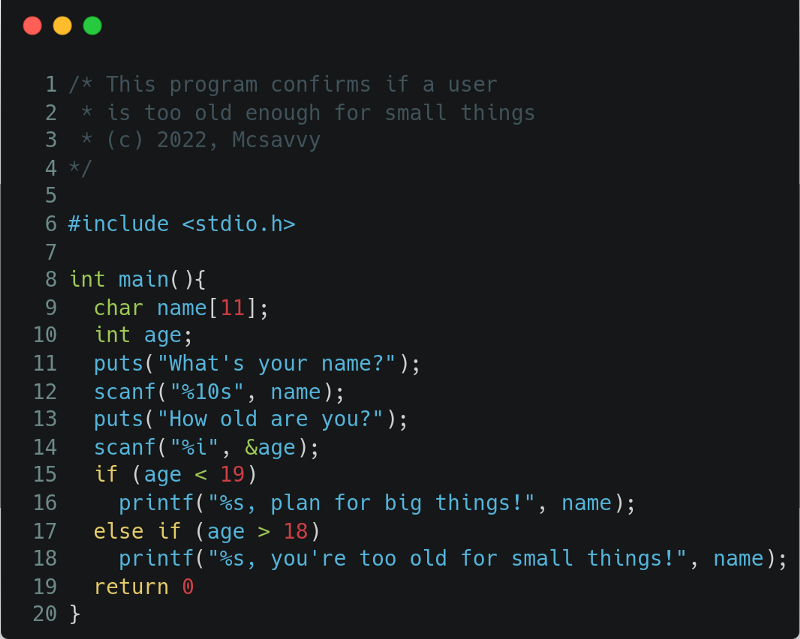
our first C program
But how do you run the program?
C is a compiled language, which means that the computer will not interpret the code directly. Instead, you will need to convert — or compile — the human-readable source code into machine-readable machine code.
To compile, you need a program called a compiler. One of the most popular C compilers is the GNU Compiler Collection or gcc for short. gcc is available on a lot of operating systems, and it can compile lots of languages other than C.
Here’s how you can compile and run the program above using gcc
- copy and save the program above to a file called
bigthings.c - compile with
gcc bigthings.c -o bigthingsat a command line or terminal - run by typing
bigthingson windows or./bigthingson Mac and Linux machines.


